Explore the area

bourtzi
The Fortress of History and the Sea

Bourtzi is a small island-fortress in the Argolic Gulf and one of the most important fortification monuments in Greece. Its original construction dates back to the period of the First Venetian Rule, under the provveditore (governor) of Nafplio, Vittore Pasqualigo, and it was initially named Castel Pasqualigo. During the Venetian period, it was also known as the “fortress of the rock” or “of the sea,” while during the Greek War of Independence it was referred to as the “sea tower” or “Kasteli.” The name “Bourtzi”, by which it is known today, derives from the Turkish word bürç, meaning fortress.

The purpose of the fortress was to protect the entrance of the port of Nafplio, in cooperation with the bastion of the “Five Brothers,” as this was the only side through which large ships could enter, since the shallow waters on the northern side hinder navigation. Throughout its history, it was used as a residence for guards and executioners, and in later years it was converted into a hotel until the 1960s. In 1865, King George I disarmed the fortress, and today it stands as one of Nafplio’s most popular tourist attractions.

Access to Bourtzi is easy by boat from the port, and during the summer months it hosts musical and cultural events featuring Greek and international artists. With its illuminated presence in the Argolic Gulf, Bourtzi continues to keep the city’s history alive, combining culture, panoramic views, and the magic of the sea of Nafplio.

palamidi
The Jewel of Nafplio

Iconic and emblematic of Nafplio, Palamidi is an impressive Venetian fortress perched atop a hill 216 meters above the city. Construction began in 1711 by the Venetians and was completed in 1714, making it today one of the top destinations for visitors, offering a journey that blends breathtaking views with rich history.

Famous for its 999 steps (actually 857), Palamidi invites you to explore it either by the traditional climb or via the vehicle-accessible road. The panoramic views of Nafplio’s harbor and the Argolic Gulf reward every step of the way.

The fortress is also a significant site of historical memory: its underground cells once held many fighters of the Greek War of Independence, including figures connected to the generation of Kolokotronis. Visitors can explore the dungeons, dark corridors, ramparts, and cannons, feeling the history alive in every stone.

With its natural beauty and historical significance, Palamidi is perfect for a leisurely walk, photography, moments of calm, or an educational tour for both young and old. Every visit is a unique experience connecting travelers to Nafplio’s rich heritage.

lion

Between the Church of All Saints and the city’s current cemetery, on Michail Iatrou Street, stands one of the most important 19th-century sculptures in Greece: the Lion of the Bavarians, dating from 1840–1841.

The monument, carved in monumental scale from rock, depicts a sleeping lion, symbolizing strength and protection. The sculpture was created by the German artist Christian Ziegel, the first professor of sculpture at the Athens Polytechnic, and was inspired by the famous Lion of Lucerne by the Danish sculptor Bertel Thorvaldsen.

Below the lion, a German inscription informs visitors that the monument was commissioned by the King of Bavaria, Ludwig, father of Greece’s first king, Otto, in memory of the Bavarian soldiers of Otto’s entourage who died from typhus in Nafplio in 1833–1834. The soldiers were originally buried in the nearby All Saints Cemetery and an area northeast of the Church of the Evangelistria, known as the “Bavarian Graves.” Their remains were later moved to the crypt of Nafplio’s Catholic Church.

Today, the area in front of the Lion has been turned into a small park with benches, offering visitors a peaceful spot to rest while exploring the old town. The Lion of the Bavarians remains a monument of historical memory and cultural significance, connecting Nafplio to the early years of the newly established Greek state.

museum

The building that now houses the Archaeological Museum of Nafplio is one of the city’s most important Venetian structures and marks the end of the historic “Great Road.” On its façade, a Latin marble inscription states that the building was constructed in 1713 by the Venetian Fleet Governor, Augustino Sagredo, to serve as a storage facility for the fleet.

It is a two-story monumental building with subtle Baroque features. The ground floor features an arched portico supported by four pillars, while the arches and window frames display stones in the rustic style. The upper floors are distinguished by porous stone bands, and the building’s emphasized symmetry conveys a sense of austerity and simplicity, reflecting its original military function.

After the Venetian period, the arsenal was used as a barracks, giving the nearby square the name “Platia Stratonos.” During the German occupation, it housed the German interrogation offices.

Today, the building accommodates the Archaeological Museum of Nafplio on its two floors, while the ground floor hosts the offices of the Fourth Ephorate of Prehistoric and Classical Antiquities. The museum showcases the cultural history of Argolis from the Paleolithic to the Roman period, making it a key destination for visitors who wish to combine history, archaeology, and architecture in one experience.

parliament
History, Architecture, and Significance

The Boulevetiko is one of the most historic and recognizable buildings in Nafplio, standing prominently in Syntagma Square, a central and key location in the city.

The building dates back to the late 18th century and originally served as a Turkish mosque. It is a representative example of mature Ottoman architecture, with Doric proportions and a large dome, reflecting its important role in the urban life of the period.

Originally, there was also a western colonnade with smaller domes, showing how the building was integrated into the city’s social and commercial network. However, this colonnade was destroyed in the early 20th century by an earthquake.

After Nafplio was liberated from Ottoman rule, the building was repaired and in September 1825 it became the first Parliament of Greece, when the city served as the capital of the newly established Greek state. This period marks the building as an important milestone in the history of Greek democracy and political life.

After 1826, when the Parliament moved to Athens, the Boulevetiko was used for various purposes, including educational and administrative functions, and at times even served as a prison.

Today, the Boulevetiko has been fully restored by the Ministry of Culture, highlighting its architectural features such as the dome’s proportions, finely cut stones, and historical value.

The building now serves as a conference and cultural venue, hosting exhibitions and lectures, art and history workshops, cultural events, and book presentations, remaining a landmark in the city’s cultural life. A living monument that connects the history of Nafplio with its contemporary life.

st. spiridon

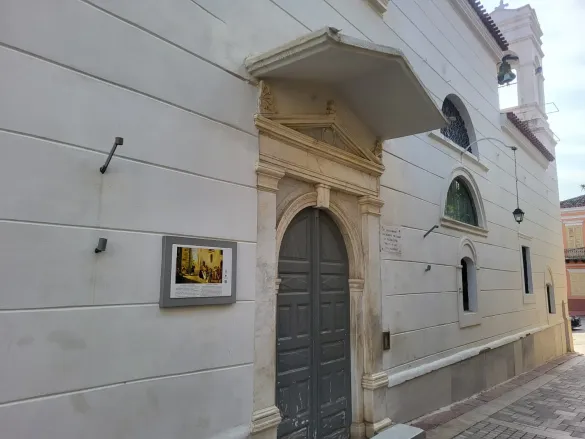
The Church of Agios Spyridon, located in the heart of Nafplio’s old town, is not only a place of worship but also a historic site of global significance. Right next to the church entrance is the spot where Ioannis Kapodistrias, the first Governor of Greece, was assassinated on September 27, 1831, by the brothers Mavromichalis.

This assassination was a decisive moment in Greek history, ending the life of a leader who had devoted himself to organizing and consolidating the newly established Greek state.

Visitors can see the commemorative marker in the alley beside the church and learn about the dramatic events that shook the nation at that time.

The church, with its simple yet elegant architecture, remains an active place of worship, while the surrounding area forms part of a historic walking route. Here, the story of Kapodistrias’ assassination serves as a memorial and point of reference for every visitor wishing to understand the political and historical importance of Greece’s first Governor.

EVENTS

Rent Our area for your event

Our spaces are available for events, business meetings, private parties, and personal moments, while our DJs provide a tailored soundtrack to every gathering.


kyklio-logo_white Discover Nafplio & the Peloponnese

Euclid Street, 212 00 Nafplio


© KYKLIO. All rights reserved.
Powered by POSITIVE designlab.